
 home
home
 Published: Apr 12, 2026 08:49 PM
 Page View: 171
In the world of industrial automation and process control, SIS (Safety Instrumented System) and DCS (Distributed Control System) are two pivotal systems. While both play critical roles in monitoring and controlling industrial processes, they differ significantly in their design objectives, functions, application areas, and safety requirements. Understanding these differences is crucial for engineers, process control experts, and industrial automation system designers to ensure the right system selection based on industry needs.
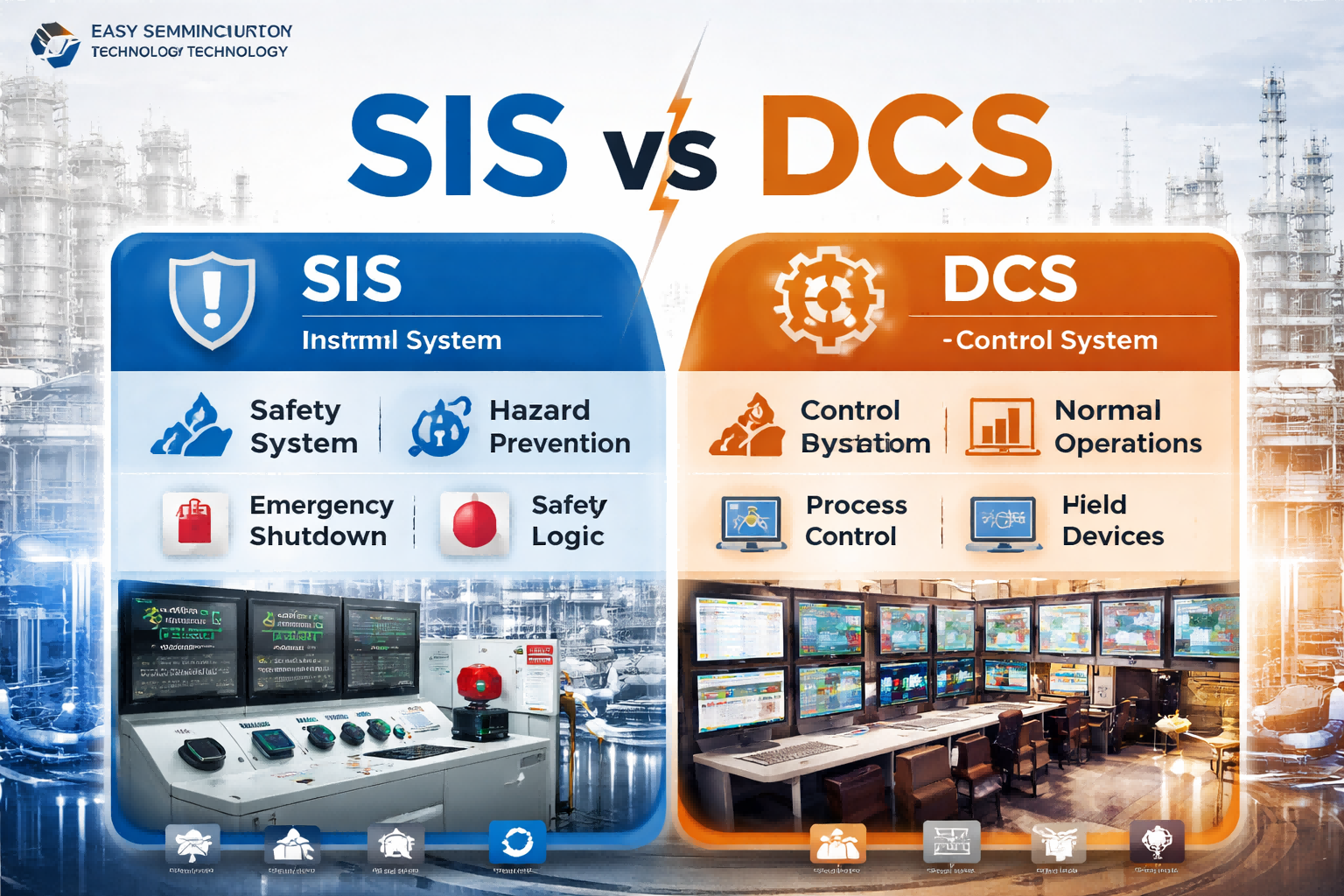
An SIS system is specifically designed to ensure the safety of industrial operations by protecting personnel, the environment, and equipment from hazardous situations. Its primary function is to automatically initiate corrective actions during dangerous conditions, preventing accidents and minimizing potential damage. Safety Instrumented Systems are typically employed in high-risk industries such as petrochemical, pharmaceuticals, nuclear energy, and mining.
The SIS system works by integrating sensors, controllers, and actuators to monitor process conditions. When a potential safety threat is detected, the system automatically initiates predefined safety protocols, such as emergency shutdowns or other protective measures.
A DCS system is used to monitor and control complex industrial processes in real-time. The DCS is primarily focused on process optimization, accurate control, and efficiency. It is widely implemented in industries such as energy, chemical processing, food production, and water treatment. Unlike SIS, which emphasizes safety, DCS systems are designed to provide continuous process management, improve performance, and enhance operational stability.
DCS systems consist of various components such as control units, operator stations, databases, and field devices. The system not only monitors operational parameters but also adjusts them to optimize the entire production process.
The architecture of SIS systems emphasizes redundancy and high reliability. To ensure safety, SIS systems often include redundant components (such as sensors, controllers, and actuators), ensuring that the system remains functional even if one component fails. SIS systems must meet strict safety standards, such as IEC 61508 and IEC 61511, and are used in safety-critical environments.
In terms of structure, SIS systems generally have a simplified control layout: sensors, logic controllers (such as PLC), and actuators. The controller evaluates input signals and triggers emergency actions when necessary.
The architecture of DCS systems is more complex, designed to handle large-scale operations and support a variety of real-time control functions. A typical DCS includes control units, operator stations, distributed databases, and field devices. DCS focuses on optimizing production processes through continuous monitoring and adjustment of operational parameters.
DCS systems provide the flexibility needed for large-scale production environments and are designed to integrate various control strategies to maintain system stability and efficiency.
SIS systems are designed with safety as the top priority. These systems must ensure functional safety, meaning they are capable of taking corrective actions automatically in case of a failure, thereby protecting personnel and preventing catastrophic incidents. The safety systems are often tested to meet international standards and have robust fault tolerance to guarantee system availability.
While DCS systems incorporate some fault tolerance features, such as redundant configurations and backup systems, their primary focus is on optimizing production processes and maintaining system stability. DCS is not as safety-centric as SIS, although modern systems do include safeguards to protect against system failures.
SIS systems are most often deployed in industries where safety is paramount. Some of the common sectors include:
Oil and gas production
Chemical manufacturing
Nuclear power plants
Hazardous material handling
In these industries, the key goal of SIS is to prevent accidents and protect both human life and the environment from potential hazards.
DCS systems are widely used in industries that require precise control over production processes. These include:
Power generation
Chemical and pharmaceutical processing
Food and beverage manufacturing
Water and wastewater treatment
DCS systems ensure process efficiency and control in these sectors, allowing operators to adjust production parameters and optimize processes for maximum output.
Key performance indicators for SIS include system response time, safety function availability, redundancy, and system reliability. These KPIs are critical to ensuring that the safety system is operational and can react swiftly to potential hazards.
For DCS, KPIs are focused on process control precision, system response speed, network stability, and scalability. DCS systems need to be able to manage large-scale operations while maintaining high control accuracy and optimizing production processes in real time.
While both SIS and DCS systems are essential for modern industrial automation, they serve distinct purposes. SIS is primarily focused on ensuring safety and mitigating risk in hazardous environments, while DCS optimizes production efficiency, control, and monitoring. The choice between these systems depends on the specific needs of the industry, as well as safety considerations.
For high-risk sectors where safety is the top priority, an SIS is essential. On the other hand, in industries requiring real-time process optimization, a DCS system is more suitable for achieving high production efficiency.
At Easy Semiconductor Technology (Hong Kong) Limited, we specialize in providing cutting-edge semiconductor solutions for industries worldwide. If you're looking to integrate SIS or DCS systems into your operations, we can help you choose the best system for your specific needs, ensuring both safety and process optimization.