
 home
home
 Published: May 09, 2026 01:34 PM
 Page View: 141
In today’s highly competitive industrial environment, automation systems are the backbone of manufacturing efficiency, production stability, and operational safety. From PLCs and DCS systems to SCADA platforms, HMI interfaces, industrial networks, and field instruments, every component plays a critical role in maintaining continuous production. However, many enterprises still rely heavily on reactive maintenance—repairing equipment only after failures occur—which often leads to costly downtime, production losses, and safety risks.
Preventive maintenance offers a smarter and more sustainable approach. Instead of waiting for failures, preventive maintenance focuses on regular inspections, early fault detection, planned servicing, and lifecycle management to ensure systems operate reliably over the long term. Industry reports show that predictive and preventive maintenance strategies can reduce unplanned downtime by up to 50% and lower maintenance costs significantly when compared to reactive models. As a professional industrial automation service provider, Easy Semiconductor Technology (Hong Kong) Limited helps global industrial plants improve equipment reliability through comprehensive preventive maintenance solutions. Here are the best practices for preventive maintenance in automation systems. The foundation of effective preventive maintenance is a well-structured and customized maintenance schedule. Every factory has unique production processes, operating conditions, and equipment configurations, so maintenance plans should never follow a one-size-fits-all model. Critical equipment such as DCS controllers, PLC CPUs, communication modules, and redundant power systems should be inspected more frequently. Secondary devices such as HMIs, operator stations, and field transmitters can follow longer maintenance intervals. Maintenance plans should include: Weekly visual inspections Monthly environmental checks Quarterly electrical testing Semi-annual system backups Annual performance evaluations Lifecycle replacement planning for aging components This structured approach minimizes unexpected failures and improves long-term operational stability. A large percentage of automation failures originate from poor power quality and harsh environmental conditions rather than component defects. Voltage fluctuations, grounding problems, dust accumulation, excessive humidity, overheating, and cabinet contamination can all shorten equipment lifespan. Control cabinets should be inspected regularly for: Stable input voltage UPS performance Grounding integrity Cooling fan operation Filter cleanliness Cabinet temperature and humidity Corrosion or moisture intrusion Advanced condition monitoring is becoming one of the top industrial maintenance trends in 2026, especially for identifying abnormal heat, vibration, and electrical instability before major failures occur. One of the most overlooked risks in automation systems is the loss of configuration data and control programs. PLC logic, DCS databases, HMI recipes, SCADA archives, historian records, and network configurations should be backed up regularly and securely stored both locally and offsite. Best practices include: Monthly program backups Version-controlled engineering files Updated wiring diagrams Asset lifecycle records Spare parts documentation Firmware version tracking Maintenance history reports Without reliable backups, even a small controller failure can result in days or weeks of downtime. Preventive maintenance is not only about inspection—it also involves proactive replacement of components before end-of-life failure occurs. Examples include: PLC backup batteries Power supply modules Cooling fans Relays and contactors Network switches Communication modules Capacitors in drives and power systems Many control cabinets fail because small low-cost parts are ignored until they trigger major shutdowns. Some maintenance experts specifically warn that dead PLC backup batteries can lead to total logic loss after power interruptions. Lifecycle management should be based on manufacturer recommendations, runtime conditions, and failure history rather than waiting for breakdowns. Maintenance quality improves significantly when inspection procedures are standardized. Technicians should follow clear checklists instead of relying solely on personal experience. Standardized preventive maintenance reduces human error and ensures consistency across shifts and maintenance teams. Inspection checklists may include: Signal integrity verification I/O module diagnostics Communication network testing Alarm history review Sensor calibration Valve and actuator response testing Safety interlock verification Digital CMMS systems are increasingly replacing spreadsheets for PM scheduling because they improve task visibility, asset history, and technician accountability. Many maintenance professionals also note that success depends heavily on simple mobile workflows and technician adoption rather than software alone. Even the best maintenance strategy fails without skilled personnel. Automation technologies evolve rapidly, and maintenance teams must stay updated on new PLC platforms, cybersecurity risks, industrial Ethernet systems, and vendor-specific diagnostics. Regular technical training should cover: Troubleshooting methodology Root cause analysis Vendor platform updates Cybersecurity awareness Backup recovery procedures Emergency response protocols Well-trained technicians reduce downtime because they can identify the real source of problems faster and avoid unnecessary part replacement. Traditional time-based preventive maintenance is highly effective, but the future lies in predictive maintenance supported by IIoT, AI, and condition monitoring technologies. Modern systems use: Vibration analysis Thermal monitoring Power quality analysis Real-time diagnostics Performance trend monitoring AI-driven fault prediction Instead of replacing parts based only on schedule, predictive maintenance identifies actual equipment health and recommends intervention only when needed. In 2026, leading manufacturers are rapidly moving from schedule-based maintenance to predictive and prescriptive maintenance models driven by real-time asset monitoring. Preventive maintenance is not an expense—it is a strategic investment in reliability, productivity, and plant safety. For automation systems, the best practices include customized planning, environmental control, reliable backups, proactive replacement, standardized inspections, skilled personnel, and the gradual adoption of predictive maintenance technologies. Companies that prioritize preventive maintenance reduce downtime, lower repair costs, improve production efficiency, and extend equipment lifespan. In modern industrial operations, the true cost lies not in maintenance itself, but in the consequences of neglecting it. Easy Semiconductor Technology (Hong Kong) Limited provides professional preventive maintenance services for PLC, DCS, SCADA, turbine monitoring systems, and industrial control infrastructure—helping enterprises achieve stable, safe, and uninterrupted production.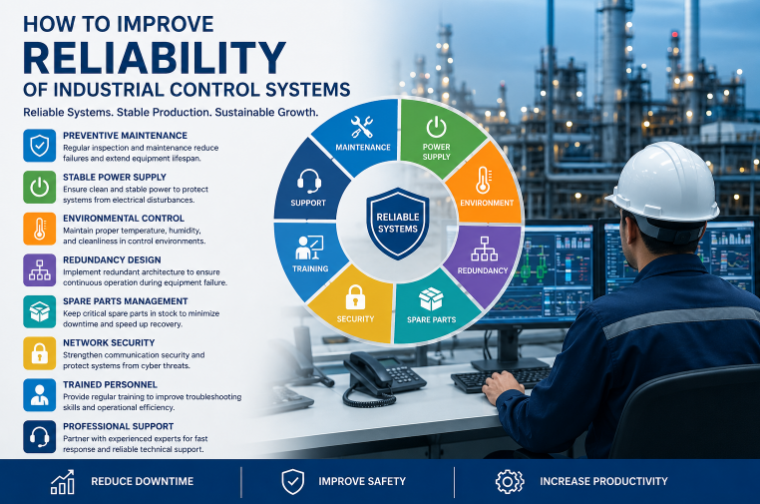
1. Establish a Customized Maintenance Plan
2. Focus on Power Supply and Environmental Conditions
3. Maintain Complete Backup and Documentation
4. Replace Aging Components Before Failure
5. Standardize Inspection Procedures
6. Train Maintenance Teams Continuously
7. Transition from Preventive to Predictive Maintenance
Conclusion