
 home
home
 Published: Apr 02, 2026 03:34 PM
 Page View: 180
Released by: Easy Semiconductor Technology (Hong Kong) Limited | Release Date: April 2, 2026
In the rapidly evolving landscape of industrial automation, Programmable Logic Controllers (PLCs) have become the backbone of modern manufacturing and process control systems. As a trusted provider of industrial automation components, Easy Semiconductor Technology (Hong Kong) Limited (hereinafter referred to as "Easy Semiconductor") delivers a comprehensive analysis of the advantages and disadvantages of PLCs. This analysis aims to help industrial enterprises, engineers, and procurement professionals make informed decisions when selecting, implementing, and optimizing PLC-based control systems, aligning with the core needs of B2B industrial users in the procurement evaluation phase.
PLCs, as industrial-grade programmable control devices, have revolutionized the way industries operate by replacing traditional relay logic control systems. They offer unparalleled flexibility, reliability, and efficiency, but like any technology, they also come with inherent limitations. Easy Semiconductor, with years of experience in supplying high-quality PLCs and supporting solutions, combines industry practice, technical insights, and user feedback to objectively dissect the pros and cons of PLCs, providing valuable guidance for businesses across petrochemical, semiconductor manufacturing, power energy, and other key industrial sectors.
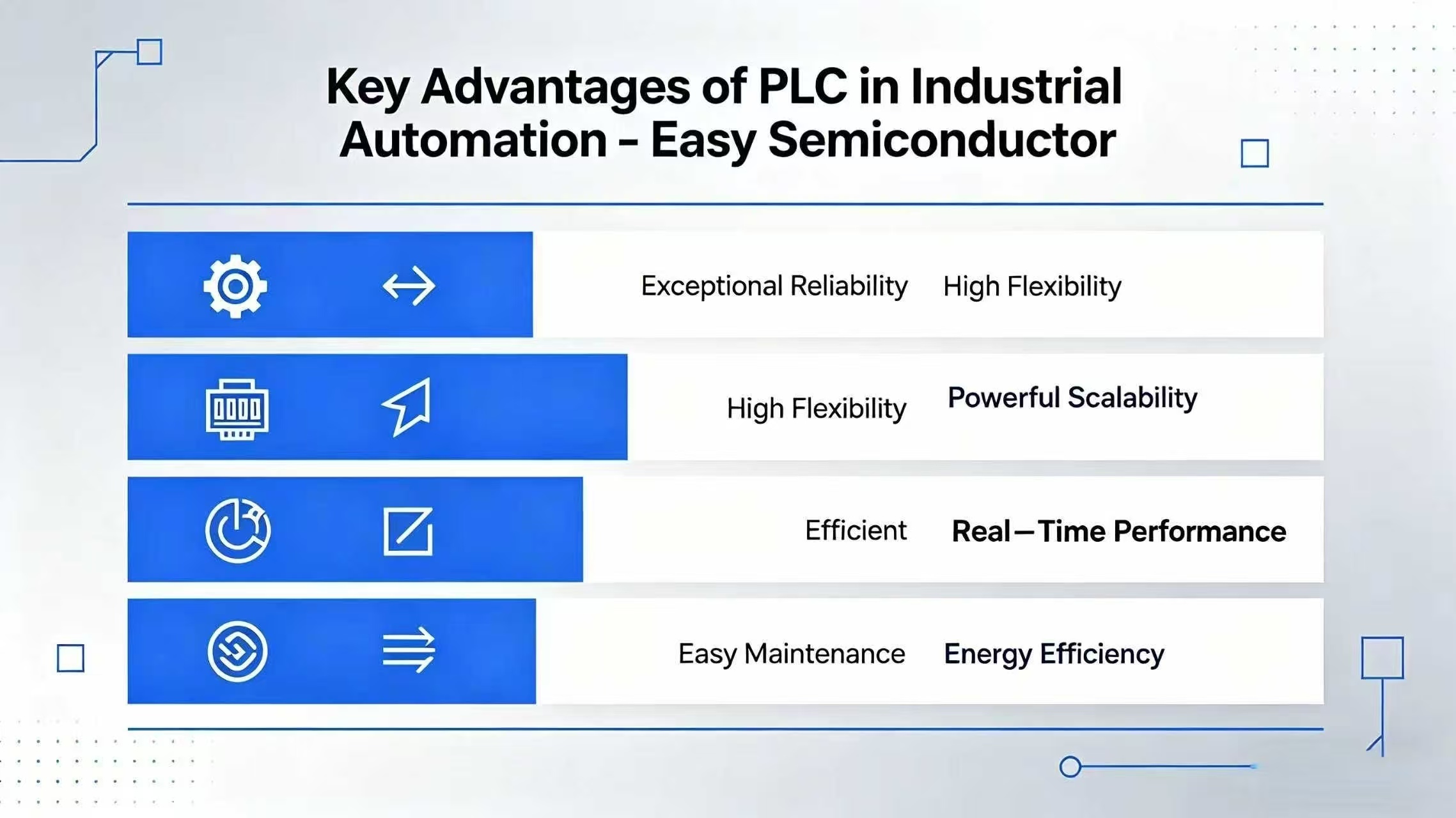
PLCs have gained widespread adoption in industrial automation due to their unique advantages that address the pain points of traditional control systems. Easy Semiconductor summarizes the six most prominent advantages, supported by industry data and practical application cases, to highlight the value of PLCs for industrial operations:
Unlike traditional relay control cabinets, PLCs are built with industrial-grade components and adopt advanced anti-interference designs, including photoelectric isolation, electromagnetic shielding, and surge protection technologies. This enables them to operate stably in harsh industrial environments characterized by high temperature, humidity, vibration, and strong electromagnetic interference – conditions common in chemical plants, power stations, and manufacturing facilities. According to industry statistics, the average trouble-free operation time of PLCs is 5-10 times that of relay control systems, with a failure rate as low as 0.01% per 1000 hours. Easy Semiconductor’s PLC products further enhance this reliability through strict quality control, ensuring continuous operation for industrial production lines and reducing unplanned downtime.
The control logic of PLCs is realized through user-programmed software, eliminating the need for physical wiring modifications when production processes change. Engineers can quickly update programs using intuitive programming languages such as ladder logic (LD), function block diagram (FBD), and structured text (ST) – languages that are easy to learn and master for industrial technicians. For example, when a food processing enterprise adjusts its packaging process, PLC programs can be modified within a few hours to adapt to the new requirements, whereas traditional relay control systems would require days of rewiring and hardware replacement, increasing costs and production disruption. This flexibility makes PLCs ideal for dynamic production environments where process adjustments are frequent.
Modular PLC designs, a core feature of most modern PLCs, allow users to flexibly expand I/O points, communication modules, and functional modules according to production scale expansion or process upgrades. This means enterprises do not need to replace the entire PLC system when their control needs grow – they can simply add modules to extend functionality. For large-scale industrial projects, multiple PLCs can be networked to achieve centralized control and distributed management, supporting the control of entire factories or production parks. Easy Semiconductor offers a full range of modular PLCs, compatible with mainstream communication protocols such as Modbus, Profibus, and Ethernet/IP, ensuring seamless scalability and compatibility with existing automation systems.
PLCs operate on a "sequential scanning, continuous cycle" working mode, with scanning cycles as short as milliseconds. This enables real-time collection of input signals, rapid execution of control logic, and timely output of control commands, ensuring precise and timely control of industrial processes. For high-speed production scenarios such as automotive assembly lines and semiconductor wafer processing, PLCs can respond to input signals in less than 1ms, guaranteeing the accuracy and efficiency of production operations. This real-time performance is crucial for applications requiring precise synchronization and rapid adjustment, such as robotic control and high-speed conveyor systems.
PLCs are designed with user-friendliness in mind. Their programming languages are intuitive and close to traditional electrical circuit diagrams, making them easy for engineering technicians to learn and operate. Additionally, most PLCs are equipped with perfect fault self-diagnosis functions, which can quickly locate fault points (such as I/O module failures, power module malfunctions, or communication errors) and display fault codes on the operation panel or through upper computer software. This reduces the difficulty and time required for maintenance – the average fault repair time for PLCs is less than 30 minutes, compared to 4 hours or more for traditional relay control systems. Easy Semiconductor also provides one-stop technical support and maintenance services, further simplifying PLC operation and maintenance for users.
Modern PLCs adopt high-efficiency power modules and intelligent control logic, which can optimize the operation of industrial equipment to reduce energy consumption. For example, in motor control applications, PLCs can adjust the motor’s operating state according to actual production demand, avoiding unnecessary energy waste. A case study from a chemical plant using Easy Semiconductor’s PLCs showed a 12% reduction in monthly electricity consumption after optimizing production scheduling through PLC-based control. Although the initial investment in PLCs may be higher than traditional control systems, the long-term cost savings from reduced energy consumption, lower maintenance costs, and improved production efficiency make PLCs a cost-effective choice for industrial enterprises.
The following image shows the key advantages of PLCs in industrial applications, with clear English annotations to intuitively present their core value: