
 home
home
 Published: May 09, 2026 12:47 PM
 Page View: 135
The global oil and gas industry is undergoing rapid digital transformation as companies continue upgrading automation infrastructure to improve operational safety, production efficiency, and system reliability. However, with increasing dependence on industrial control systems, Distributed Control Systems (DCS), PLC platforms, SCADA networks, and remote monitoring technologies, the importance of fast system recovery solutions has become more critical than ever.
To address growing industry demand for operational continuity and reduced downtime, Easy Semiconductor Technology (Hong Kong) Limited highlights the importance of fast recovery strategies for oil & gas automation systems, helping industrial facilities improve resilience against unexpected failures, hardware damage, communication interruptions, and cyber-related operational risks.
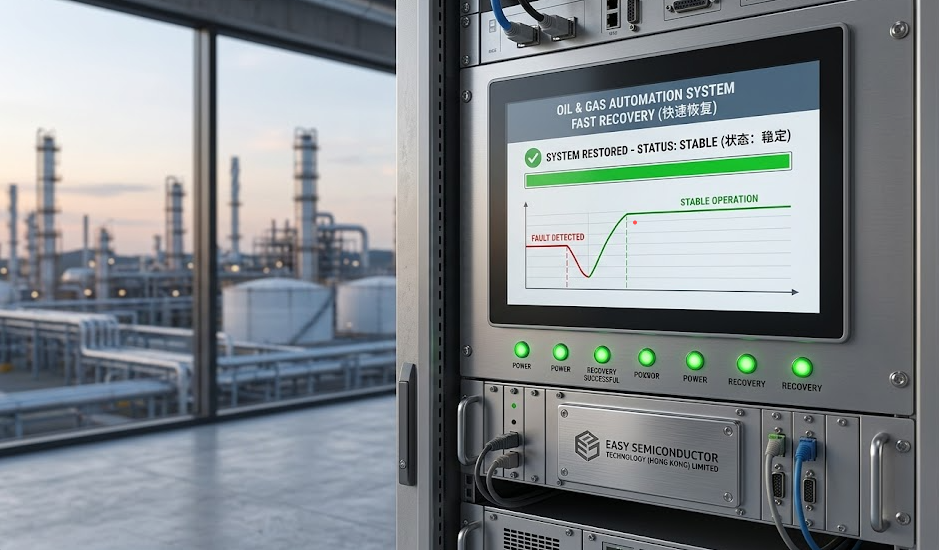
Modern oil and gas facilities rely heavily on automated control systems for upstream exploration, offshore platforms, pipeline transportation, refinery processing, LNG terminals, and petrochemical production. These systems operate continuously under harsh environmental conditions including:
High temperatures
Humidity and corrosion
Vibration and electrical interference
Remote offshore locations
Hazardous operating zones
When critical automation equipment experiences failure, production interruptions can lead to substantial financial losses, safety risks, and environmental concerns.
Industry experts report that even a short disruption in PLC or DCS communication can affect critical processes such as:
Pressure regulation
Flow control
Emergency shutdown systems
Gas compression monitoring
Refinery process sequencing
Pipeline leak detection
As industrial facilities become more interconnected, the need for rapid recovery and reliable spare part support continues growing worldwide.
Fast recovery solutions refer to integrated strategies designed to minimize operational downtime after automation system failures. These solutions combine hardware availability, backup planning, rapid diagnostics, and technical support to restore industrial systems as quickly as possible.
Key elements typically include:
Maintaining access to industrial automation spare parts is essential for minimizing delays during equipment replacement.
Many oil & gas operators deploy redundant PLCs, servers, communication networks, and power supplies to ensure continuous operation during component failures.
Modern facilities increasingly use automated configuration backups, virtualized servers, and cloud-assisted monitoring systems to accelerate system restoration.
Advanced remote troubleshooting technologies allow engineers to identify and resolve issues without lengthy onsite intervention.
Many industrial facilities still operate older control platforms that are no longer actively manufactured. Reliable sourcing of legacy automation modules has become an important part of recovery planning.
Unlike general manufacturing sectors, oil & gas production environments require extremely high system availability. Unplanned downtime can impact:
Production output
Worker safety
Environmental compliance
Supply chain stability
Energy distribution reliability
Fast recovery capability helps companies:
Reduce operational risks
Improve equipment reliability
Lower maintenance costs
Maintain regulatory compliance
Extend system lifecycle performance
As energy demand continues increasing globally, operators are investing more heavily in predictive maintenance and emergency recovery preparedness.
A complete fast recovery strategy often involves various industrial automation technologies, including:
PLC modules
DCS controllers
Industrial communication cards
HMI interfaces
Power supply systems
Industrial Ethernet switches
Servo drives and motor control units
SCADA servers
Remote I/O systems
High-quality replacement components allow facilities to restore operations faster and reduce extended shutdown periods.
According to Easy Semiconductor Technology (Hong Kong) Limited, global demand for industrial automation spare parts has grown significantly as energy companies modernize infrastructure while continuing to maintain legacy control systems.
The integration of Industry 4.0 technologies is changing how oil & gas companies approach automation recovery solutions.
Emerging technologies now include:
AI-driven predictive maintenance
Edge computing platforms
Real-time asset monitoring
Industrial cybersecurity systems
Cloud-connected SCADA environments
Digital twin simulations
These innovations enable operators to predict equipment failures earlier and improve recovery speed during unexpected system events.
Many industrial facilities are also implementing centralized monitoring centers capable of managing multiple production sites simultaneously, improving coordination during emergency recovery situations.
The oil & gas automation industry continues facing supply chain challenges related to semiconductor shortages, extended manufacturing lead times, and increasing demand for industrial electronic components.
As a result, reliable inventory management and fast international logistics have become critical factors in automation system recovery planning.
Easy Semiconductor Technology (Hong Kong) Limited continues supporting customers worldwide by supplying industrial automation components, PLC modules, DCS spare parts, HMI systems, industrial communication products, and control system solutions for industries including oil & gas, petrochemical, manufacturing, marine, and power generation.
By focusing on fast delivery capability, technical support, and global sourcing solutions, the company helps industrial customers improve operational continuity and reduce costly downtime risks.
As industrial facilities become increasingly automated and interconnected, fast recovery capability will remain a top priority for energy companies worldwide. Future developments are expected to focus on:
Intelligent fault prediction
Autonomous recovery systems
AI-assisted diagnostics
Cybersecurity resilience
Fully integrated smart field operations
Industry analysts believe companies that invest in proactive recovery infrastructure today will achieve greater operational flexibility and long-term competitiveness in the evolving global energy market.