
 home
home
 Published: May 30, 2026 01:51 PM
 Page View: 117
In today’s competitive industrial landscape, factory automation equipment is central to achieving high productivity, precision, and operational efficiency. From robotics and conveyor systems to PLC-controlled machinery, these assets are critical for ensuring uninterrupted production. However, unplanned downtime due to equipment failure can result in significant financial losses and reduced operational efficiency. Preventive maintenance (PM) has therefore emerged as a key strategy for industrial operators seeking to maintain system reliability and extend equipment life.
Preventive maintenance involves scheduled inspections, servicing, and performance checks aimed at detecting potential issues before they escalate into critical failures. By adopting a structured PM strategy, manufacturers can reduce emergency repairs, minimize production interruptions, and optimize overall equipment effectiveness (OEE).
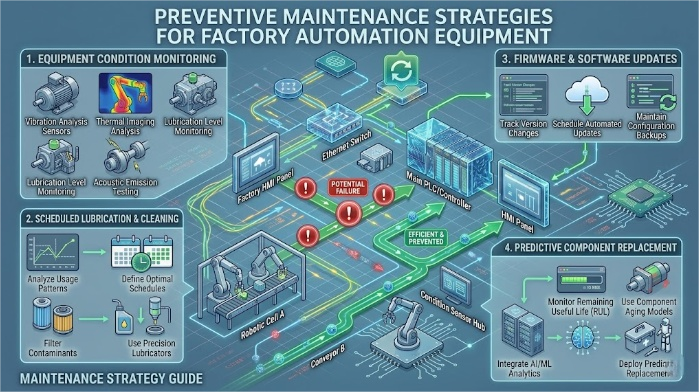
Preventive maintenance differs from corrective or reactive maintenance, where actions are only taken after a breakdown occurs. PM is proactive, relying on historical data, usage patterns, and manufacturer recommendations to schedule inspections and servicing. Common preventive maintenance activities for factory automation equipment include:
Lubrication and cleaning of mechanical components
Inspection and replacement of belts, bearings, and seals
Software updates and firmware checks for PLCs and robotics
Calibration of sensors and actuators to ensure accuracy
Electrical inspections for wiring integrity, loose connections, and insulation degradation
By addressing these factors regularly, factories can prevent small issues from turning into costly system failures.
Reduced Downtime
Scheduled maintenance reduces unexpected equipment failures, ensuring production lines remain operational. Minimizing downtime not only protects output but also strengthens customer trust in delivery timelines.
Extended Equipment Lifespan
Consistent servicing and component replacement prevent excessive wear and tear, prolonging the functional life of machinery and reducing capital expenditure for new equipment.
Enhanced Safety
Faulty automation equipment poses safety risks to personnel and products. Preventive maintenance identifies and mitigates these risks, ensuring a safer working environment.
Optimized Operational Efficiency
Regular maintenance keeps machines running at peak performance, improving speed, precision, and overall production quality.
Cost Savings
Although preventive maintenance requires upfront planning and resources, it reduces the likelihood of expensive emergency repairs and production losses, resulting in long-term financial benefits.
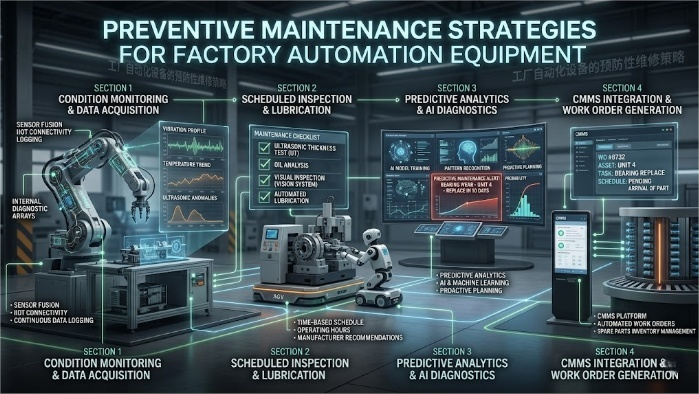
A systematic maintenance schedule should be based on manufacturer recommendations, equipment usage patterns, and historical performance data. Scheduling tasks at appropriate intervals ensures that no critical component is neglected.
Integrating condition monitoring technologies such as vibration analysis, thermography, and energy consumption monitoring allows engineers to detect early signs of equipment degradation. Predictive analytics can forecast potential failures, enabling proactive intervention.
Keeping accurate maintenance logs is essential for tracking component lifecycles, maintenance history, and recurring issues. Data-driven insights help optimize maintenance schedules and improve equipment reliability over time.
Well-trained technicians are crucial to successful PM implementation. Training should cover both mechanical and electrical systems, automation software, safety procedures, and diagnostic techniques to ensure effective maintenance execution.
Using standardized tools, checklists, and procedures improves efficiency and ensures consistency across maintenance tasks. This reduces human error and improves the reliability of maintenance outcomes.
Identify equipment whose failure would have the most significant impact on production. Prioritize preventive maintenance for these high-risk assets to reduce the likelihood of disruptive downtime.
Regularly review maintenance strategies and incorporate feedback from technicians and operational data. Continuous improvement ensures that PM practices evolve with changing production requirements and technological advancements.
The rise of Industry 4.0 and smart manufacturing has transformed preventive maintenance. IoT-enabled sensors, real-time monitoring systems, and AI-driven predictive analytics allow factories to implement more precise and dynamic maintenance schedules. Automation systems can now alert operators to anomalies, schedule maintenance tasks automatically, and even predict the remaining useful life of critical components. This convergence of preventive maintenance with digital technologies not only reduces costs but also enhances production resilience and efficiency.
While preventive maintenance offers clear benefits, it also presents challenges. Over-maintenance can lead to unnecessary downtime and costs, while under-maintenance increases the risk of failure. Balancing these factors requires careful analysis, accurate data, and ongoing evaluation of maintenance effectiveness. Additionally, integrating PM strategies into existing operations without disrupting production schedules requires careful planning and coordination across departments.
Preventive maintenance is a cornerstone strategy for ensuring reliable, safe, and efficient factory automation systems. By implementing structured schedules, leveraging predictive analytics, training personnel, and continuously improving processes, manufacturers can significantly reduce downtime, extend equipment lifespan, and optimize production performance.
As industrial operations evolve toward greater automation and connectivity, preventive maintenance remains critical for sustaining operational excellence. Easy Semiconductor Technology (Hong Kong) Limited is dedicated to supporting manufacturers with innovative solutions and expertise that enhance equipment reliability, minimize risks, and drive long-term productivity.