
 home
home
 Published: May 25, 2026 10:01 AM
 Page View: 107
As global manufacturing continues to expand in 2026, industrial component shortages remain one of the biggest challenges facing exporters, manufacturers, and automation suppliers worldwide. From semiconductors and PLC modules to sensors, relays, and communication boards, supply chain disruptions are affecting production schedules, increasing operational costs, and delaying international deliveries.
Published by Easy Semiconductor Technology (Hong Kong) Limited, this report explores the most effective strategies companies are adopting to overcome component shortages while maintaining production efficiency and customer satisfaction.
Industrial supply chains have become increasingly interconnected over the past decade. While globalization has improved efficiency and reduced manufacturing costs, it has also created vulnerabilities. A disruption in one region can quickly affect factories across multiple continents.
Several factors continue to contribute to component shortages in 2026:
Rising global demand for industrial automation
Semiconductor production bottlenecks
Geopolitical trade restrictions
Increased logistics costs
Delays in raw material procurement
Aging manufacturing infrastructure
Limited availability of legacy industrial components
Manufacturers relying heavily on programmable logic controllers (PLCs), distributed control systems (DCS), and industrial communication devices are particularly vulnerable. Many production facilities still operate with obsolete equipment that is no longer actively manufactured, making replacement parts increasingly difficult to source.
Industrial components are the backbone of modern manufacturing systems. Even a single unavailable module can halt an entire production line, resulting in significant downtime and financial losses.
Critical components affected by shortages include:
PLC processors and I/O modules
Industrial sensors
Servo drives and motors
Power supply units
Human-machine interface (HMI) panels
Communication adapters
Semiconductor chips
Industrial networking devices
For industries such as automotive manufacturing, semiconductor fabrication, pharmaceuticals, and food processing, uninterrupted access to these components is essential for maintaining productivity and meeting export deadlines.
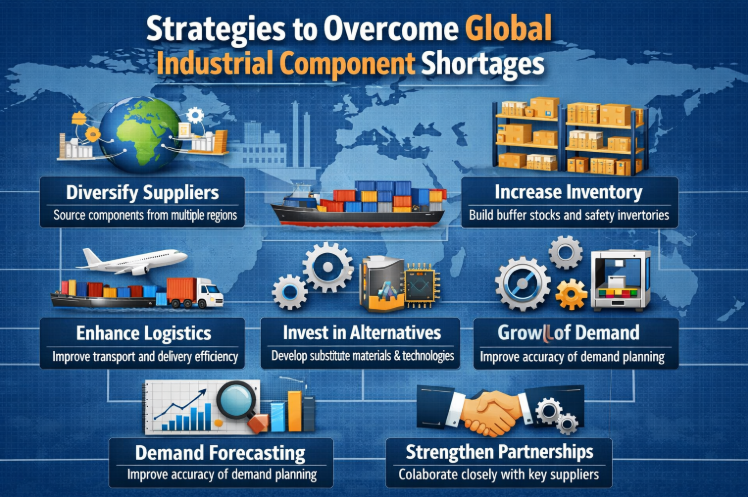
One of the most effective strategies companies are implementing is supplier diversification. Depending on a single supplier or region significantly increases operational risk.
Forward-thinking manufacturers are now building multi-region sourcing strategies that include suppliers from Asia, Europe, and North America. This approach helps reduce dependency on one market while improving procurement flexibility.
Businesses are also partnering with independent industrial component distributors that specialize in hard-to-find, obsolete, and surplus inventory. These suppliers often maintain extensive global networks capable of sourcing discontinued modules quickly.
By expanding procurement channels, manufacturers can better manage sudden shortages and reduce production interruptions.
Traditional just-in-time inventory models are being reevaluated as companies prioritize supply chain resilience over minimal inventory costs.
Many industrial organizations are now:
Increasing safety stock levels
Forecasting demand more accurately
Purchasing critical spare parts in advance
Building strategic inventory reserves
Using predictive analytics for procurement planning
Advanced inventory management software powered by artificial intelligence is also helping manufacturers identify future supply risks before they become operational problems.
Maintaining a balanced inventory strategy allows companies to respond more effectively to sudden supply disruptions while avoiding excessive overstocking.
Predictive maintenance is becoming a powerful tool for reducing the impact of component shortages. Instead of waiting for equipment failure, manufacturers can monitor machine conditions in real time and identify potential issues before breakdowns occur.
Modern predictive maintenance systems use:
IoT sensors
Smart monitoring devices
AI-driven analytics
Cloud-based diagnostics
Industrial automation software
These technologies help extend equipment life cycles and reduce emergency replacement demands for scarce components.
When companies can predict failures early, they gain more time to source replacement parts and avoid costly unplanned downtime.
As many factories continue operating older automation systems, demand for refurbished and obsolete industrial components has increased significantly.
Certified refurbished components offer several advantages:
Faster availability
Lower procurement costs
Extended equipment lifespan
Reduced capital investment
Improved sustainability
Reliable suppliers carefully test and certify refurbished PLC modules, drives, and industrial boards to ensure operational reliability.
For many manufacturers, replacing an entire automation system is financially unrealistic. Sourcing high-quality obsolete parts enables facilities to continue operating existing equipment efficiently while planning long-term modernization projects.
Strong supplier relationships have become a competitive advantage during periods of supply instability.
Companies working closely with trusted industrial distributors gain access to:
Priority inventory allocation
Faster sourcing assistance
Technical support
Alternative component recommendations
Real-time market updates
Long-term partnerships improve communication and create more reliable procurement channels during periods of high global demand.
Industrial distributors with strong international logistics capabilities can also help manufacturers overcome customs delays and shipping disruptions.
Digital transformation is playing a major role in helping manufacturers respond to supply chain uncertainty.
Cloud-based procurement systems now provide real-time visibility into:
Global inventory availability
Supplier lead times
Shipping status
Market pricing trends
Risk exposure analysis
Digital procurement platforms allow purchasing teams to make faster and more informed sourcing decisions.
At the same time, automation technologies are improving operational efficiency, reducing waste, and minimizing dependency on labor-intensive processes.
Factories adopting Industry 4.0 technologies are generally more resilient during supply chain disruptions because they can adapt more quickly to changing market conditions.
Another growing strategy involves engineering flexibility. Manufacturers are redesigning systems to support interchangeable or cross-compatible components whenever possible.
Benefits of alternative component strategies include:
Reduced dependency on specific brands
Improved sourcing flexibility
Lower procurement risk
Faster maintenance response times
Engineering teams are increasingly evaluating equivalent modules and redesigning older systems to accommodate modern replacements.
This flexibility helps organizations maintain production continuity even when original components become unavailable.
Shipping delays continue to affect industrial supply chains worldwide. Companies are now investing heavily in logistics optimization to improve delivery reliability.
Effective logistics strategies include:
Multi-carrier shipping partnerships
Regional warehousing
Flexible transportation planning
Customs clearance optimization
Real-time shipment tracking
Some organizations are also relocating portions of their manufacturing operations closer to end markets to reduce transit times and geopolitical risks.
Improved logistics planning helps manufacturers maintain stable production schedules despite ongoing global uncertainty.
Interestingly, industrial component shortages are also accelerating sustainability initiatives.
Instead of discarding older systems, many companies are embracing repair, refurbishment, and reuse strategies that support circular economy goals.
Benefits include:
Reduced electronic waste
Lower environmental impact
Extended equipment usability
Lower operational costs
Sustainable procurement strategies are becoming increasingly important for manufacturers seeking long-term operational resilience and environmental responsibility.
Although global industrial component shortages are expected to continue influencing manufacturing markets in the coming years, companies that adopt proactive sourcing and supply chain strategies will be better positioned for success.
Businesses investing in diversified sourcing, predictive maintenance, digital transformation, and strategic inventory management are gaining stronger operational stability and competitive advantages in international markets.
As industrial automation continues evolving, resilience and adaptability will become just as important as production efficiency.
With the right partnerships and procurement strategies, manufacturers can successfully navigate global supply chain uncertainty while continuing to meet customer demands and export growth objectives.