
 home
home
 Published: May 25, 2026 09:51 AM
 Page View: 108
As global manufacturing becomes more competitive in 2026, companies are under growing pressure to deliver higher quality products, reduce operational costs, and maintain reliable supply chains. Smart sensors are now playing a critical role in helping manufacturers achieve these goals, especially for businesses involved in international exports. From industrial automation systems to semiconductor production lines, smart sensing technology is transforming how factories operate across the world.
Smart sensors combine traditional sensing capabilities with advanced data processing, connectivity, and real-time communication functions. Unlike conventional sensors that only collect raw data, smart sensors can analyze information instantly and transmit actionable insights directly to industrial control systems such as PLCs, DCS platforms, and cloud-based manufacturing networks.
Export-focused manufacturers are facing increasing expectations from global buyers. International customers now demand faster production cycles, stricter quality control, and greater transparency throughout the supply chain. Smart factories equipped with intelligent sensors are becoming essential for meeting these expectations.
Industries such as semiconductor manufacturing, automotive production, food processing, electronics assembly, and pharmaceutical packaging are rapidly adopting sensor-driven automation systems. These technologies allow factories to monitor production conditions continuously while minimizing human intervention.
For exporters, this means improved consistency, lower defect rates, and enhanced compliance with international standards.
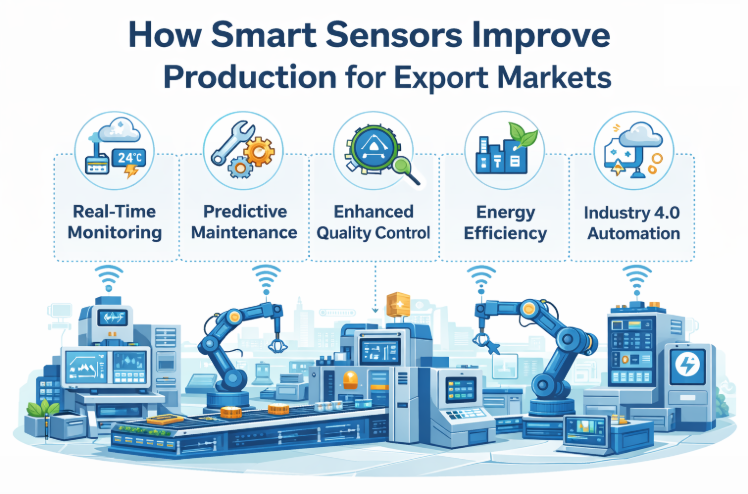
One of the biggest advantages of smart sensors is real-time monitoring. Modern production lines rely on thousands of data points collected every second. Smart sensors monitor variables such as:
Temperature
Pressure
Humidity
Vibration
Motion
Flow rates
Voltage levels
Equipment positioning
By analyzing these variables instantly, manufacturers can identify abnormalities before they become major problems. For example, vibration sensors installed on industrial motors can detect early signs of mechanical wear. Instead of waiting for equipment failure, maintenance teams can replace components proactively.
This predictive maintenance strategy significantly reduces downtime and prevents costly disruptions in export schedules.
In semiconductor manufacturing environments, even minor temperature fluctuations can affect chip quality. Smart environmental sensors help maintain stable cleanroom conditions, ensuring higher production yields and fewer rejected products.
Unexpected machine failure remains one of the largest operational risks for exporters. Delayed shipments can damage customer relationships and increase financial losses. Smart sensors help manufacturers avoid these risks through predictive maintenance systems.
Traditional maintenance approaches often rely on fixed service intervals. However, this method may replace components too early or too late. Smart sensors continuously evaluate actual machine performance and provide accurate maintenance recommendations based on real operating conditions.
For example:
Thermal sensors can identify overheating components
Oil quality sensors can detect contamination
Acoustic sensors can monitor unusual equipment sounds
Current sensors can identify electrical irregularities
When connected to industrial IoT platforms, these sensors generate automatic alerts for engineers and plant managers. As a result, factories can schedule maintenance during planned production windows instead of responding to emergency shutdowns.
For export manufacturers operating around the clock, this improvement greatly enhances production reliability.
Quality assurance is critical for export markets. Many international buyers require strict adherence to certifications and performance standards. Smart sensors help manufacturers maintain stable production quality across large manufacturing volumes.
Vision sensors and optical inspection systems are especially important in electronics and semiconductor industries. These systems can detect microscopic defects, alignment issues, and assembly errors far faster than manual inspections.
Smart sensors also support traceability throughout the production process. Every stage of manufacturing can be recorded digitally, creating detailed quality records for customers and regulatory agencies.
This level of transparency improves customer confidence and strengthens long-term export partnerships.
Energy efficiency has become a major concern for manufacturers worldwide. Rising electricity costs and stricter environmental regulations are pushing factories to optimize energy consumption.
Smart sensors help manufacturers reduce waste by monitoring energy usage in real time. Power monitoring sensors can identify inefficient machines, excessive energy consumption, or unnecessary idle operation.
Factories can then adjust production schedules, automate shutdown procedures, and optimize machine performance to reduce overall energy costs.
For exporters, sustainability is also becoming a competitive advantage. Many global buyers now prefer suppliers with environmentally responsible manufacturing practices. Smart sensor systems help companies achieve sustainability targets while lowering operational expenses.
Smart sensors are a core component of Industry 4.0 and modern industrial automation strategies. They enable seamless communication between machines, robotics systems, PLC controllers, and cloud analytics platforms.
In automated production environments, sensors guide robotic arms, monitor conveyor systems, and coordinate machine operations with minimal human supervision. This increases production speed while reducing operational errors.
Advanced factories now use AI-powered analytics combined with smart sensor networks to optimize entire production processes automatically. These systems continuously learn from production data and recommend operational improvements.
As export competition increases, manufacturers adopting Industry 4.0 technologies are gaining significant advantages in productivity and flexibility.
The semiconductor industry relies heavily on precision manufacturing. Smart sensors are essential for maintaining strict environmental control and ensuring stable process conditions.
Key applications include:
Cleanroom environmental monitoring
Wafer positioning systems
Gas flow monitoring
Vacuum pressure control
Chemical process monitoring
Equipment vibration analysis
Because semiconductor production involves extremely sensitive processes, intelligent sensing technology helps manufacturers maintain high yields and minimize material waste.
For companies supplying obsolete PLC modules, industrial automation equipment, and semiconductor components, smart sensor integration also improves inventory management and logistics tracking.
Global demand for automation technology is expected to continue growing throughout 2026 and beyond. Manufacturers across Asia, Europe, and North America are investing heavily in smart factory upgrades to remain competitive in global trade.
Exporters that adopt smart sensor technology can benefit from:
Faster production cycles
Lower operational costs
Improved product consistency
Reduced downtime
Enhanced customer satisfaction
Better compliance with international standards
As industrial digitalization accelerates, smart sensors will remain one of the most important technologies driving modern manufacturing growth.
Smart sensors are transforming global manufacturing by improving efficiency, quality control, predictive maintenance, and sustainability. For export-oriented manufacturers, these technologies provide a powerful advantage in increasingly competitive international markets.
From semiconductor facilities to industrial automation plants, companies that invest in intelligent sensing systems are better positioned to meet global customer expectations and strengthen long-term export performance.
As factories continue evolving toward Industry 4.0, smart sensors will play an even greater role in shaping the future of industrial production worldwide.