
 home
home
 Published: May 23, 2026 02:05 PM
 Page View: 115
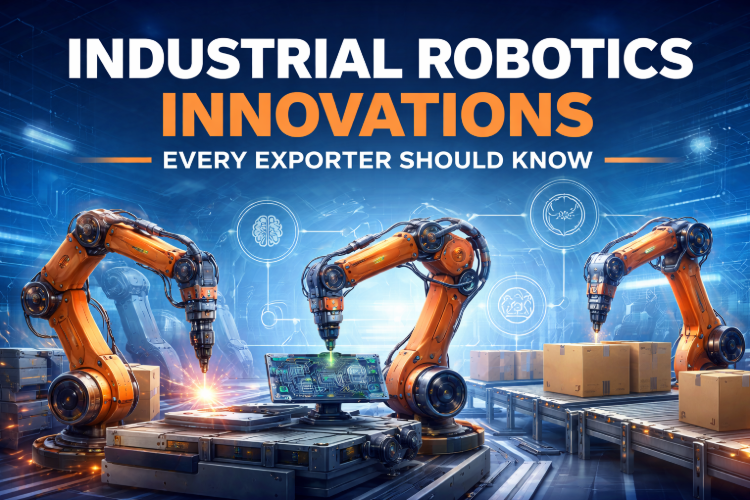
As the global manufacturing landscape continues to evolve at an unprecedented pace, industrial robotics remains at the forefront of technological innovation. For exporters seeking to maintain a competitive edge in 2026, understanding the latest advancements in robotics is not merely advantageous—it is essential. This article highlights key innovations that are reshaping the industrial robotics sector and influencing export opportunities worldwide.
1. Collaborative Robots (Cobots) Enhancing Flexibility
One of the most significant trends in industrial robotics is the rise of collaborative robots, or cobots. Unlike traditional industrial robots that operate in isolated environments, cobots are designed to work safely alongside human operators. Equipped with advanced sensors and adaptive control systems, they can perform tasks ranging from assembly to quality inspection. For exporters, cobots offer versatile solutions that reduce labor costs while increasing production efficiency, making products more competitive in global markets.
2. AI-Driven Robotics for Smarter Operations
Artificial intelligence is transforming how robots operate in industrial settings. Modern robotic systems leverage machine learning algorithms to optimize task execution, predict maintenance needs, and detect anomalies in real-time. These AI-driven capabilities not only minimize downtime but also enhance product quality. Exporters benefit by offering end products manufactured with higher precision and consistency, appealing to international buyers who demand superior standards.
3. Advanced Vision Systems for Quality Control
High-resolution vision systems are becoming integral to industrial robots. Equipped with cameras, LiDAR, and infrared sensors, these systems enable robots to perform detailed inspections, detect defects, and verify assembly accuracy. For exporters, integrating advanced vision robotics ensures that products meet stringent global quality standards, reducing returns and improving brand reputation in overseas markets.
4. Robotics-as-a-Service (RaaS) Model
The emergence of Robotics-as-a-Service is democratizing access to advanced automation. Under this model, companies can deploy robots without heavy upfront investment, paying instead for usage or subscription-based services. For export-focused manufacturers, RaaS enables rapid scaling of production to meet fluctuating international demand, while maintaining flexibility in capital expenditure.
5. Energy-Efficient and Sustainable Robotics
Environmental considerations are increasingly influencing buyer decisions worldwide. Innovations in robotics now emphasize energy efficiency, lightweight materials, and recyclable components. By adopting sustainable robotic solutions, exporters can align with global sustainability trends, enhance corporate social responsibility profiles, and access markets with strict environmental compliance requirements.
6. Integration with Smart Factories and IoT
Industrial robots are no longer standalone machines—they are integral components of connected smart factories. Through IoT integration, robots communicate with sensors, machines, and cloud platforms to enable real-time monitoring, predictive analytics, and process optimization. Exporters leveraging smart robotics solutions can achieve higher throughput, lower operational costs, and faster time-to-market for their products, which is critical in a competitive international landscape.
7. Customizable and Modular Robotic Platforms
Recent innovations have led to modular robotic systems that allow exporters to customize automation based on specific production needs. These modular robots can be reconfigured for different tasks or product lines without significant downtime. This adaptability enhances the ability to cater to diverse international markets with varying product specifications.
8. Safety Innovations Ensuring Compliance
Safety remains a top priority in industrial robotics. Advanced collision detection, force-limiting technologies, and compliance with international safety standards ensure that robotic operations meet global regulatory requirements. Exporters adopting these safety innovations can confidently market their products and production capabilities across jurisdictions with stringent safety regulations.
Conclusion
The industrial robotics landscape in 2026 is defined by collaboration, intelligence, sustainability, and connectivity. Exporters who embrace these innovations can unlock new efficiencies, enhance product quality, and strengthen their global competitiveness. By integrating cobots, AI-driven systems, advanced vision technologies, RaaS models, and sustainable practices, manufacturers are not only future-proofing their operations but also creating compelling value propositions for international buyers.
As Easy Semiconductor Technology (Hong Kong) Limited continues to monitor and adopt these cutting-edge innovations, we remain committed to providing exporters with insights and solutions that drive success in an increasingly automated and connected global economy.