
 home
home
 Published: May 09, 2026 01:11 PM
 Page View: 228
In the modern industrial landscape, the Distributed Control System (DCS) is the central nervous system of manufacturing and process plants. However, the effectiveness of a DCS is often undermined by poor alarm management. When an alarm system is poorly configured, it ceases to be a safety tool and instead becomes a source of "alarm fatigue" for operators.
Easy Semiconductor Technology (Hong Kong) Limited examines the most critical alarm challenges and provides actionable engineering solutions to ensure plant safety and productivity.
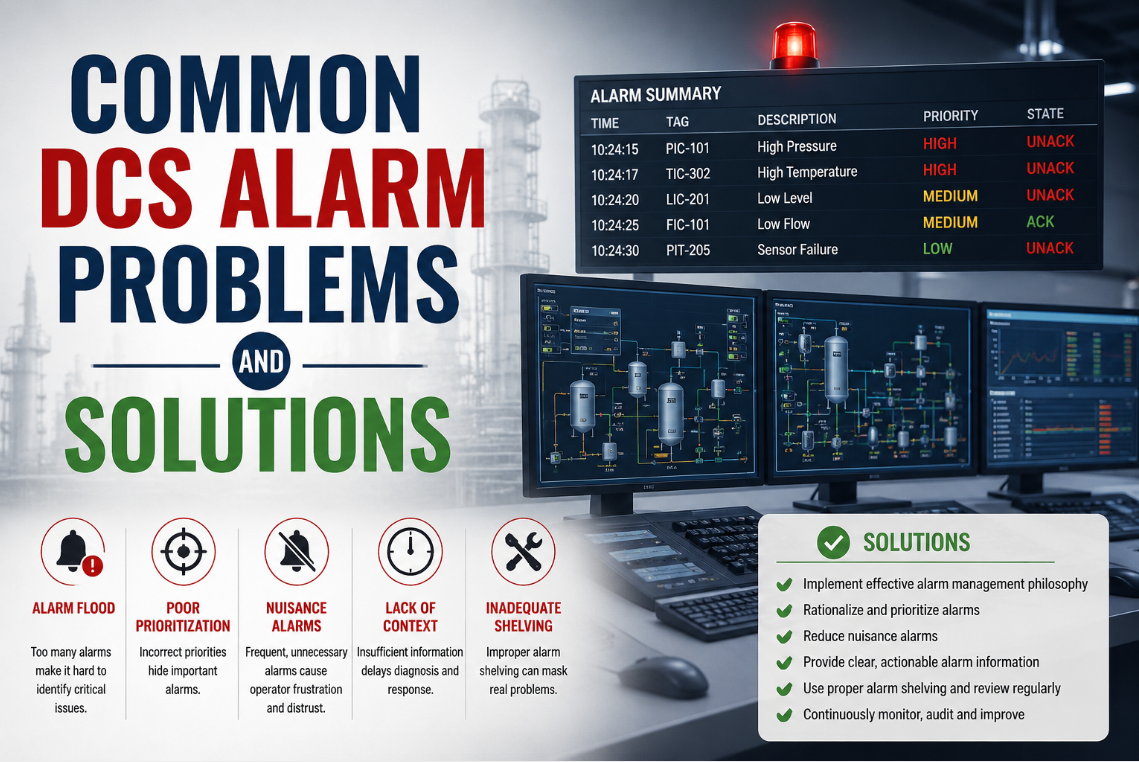
The Problem:Alarm flooding occurs when a single process upset—such as a power trip or a main feed valve failure—triggers a massive wave of alarms. During these events, it is common for operators to receive more than 10 alarms per minute, far exceeding the human capacity to process information effectively.
The Solution:
Logical Suppression: Implement "Parent-Child" logic. If a main pump stops, the system should automatically suppress "Low Pressure" and "Low Flow" alarms for that specific line.
Dynamic Alarming: Configure the DCS to change alarm setpoints or states based on the plant's operating mode (e.g., Startup, Shutdown, or Maintenance).
The Problem:A "chattering" alarm is one that rapidly transitions between the alarm and normal states. This is usually caused by process "noise" or a variable (like tank level) fluctuating right at the limit. These alarms are often ignored by operators, which is dangerous when a genuine emergency occurs.
The Solution:
Deadbands (Hysteresis): Apply a deadband to the alarm limit. For example, if a high-pressure alarm triggers at 100 psi, it should only clear when the pressure drops below 95 psi.
On/Off Delays: Use a time-delay filter. The condition must persist for a set duration (e.g., 5 seconds) before the alarm is announced to the operator.
The Problem:In many unoptimized systems, over 50% of alarms are categorized as "Critical" or "High Priority." When everything is a priority, nothing is a priority. This "priority creep" prevents operators from identifying the most life-threatening or equipment-damaging risks during a crisis.
The Solution:
Alarm Rationalization: Every alarm must be reviewed against three criteria:
Does it require an operator action?
What is the consequence of inaction?
How much time does the operator have to react?
The 5/15/80 Rule: Aim for a distribution of 5% High, 15% Medium, and 80% Low priority alarms, consistent with ISA-18.2 standards.
The Problem:Stale alarms are those that remain active for more than 24 hours. These often represent equipment that is out of service or non-critical instrument failures. They clutter the alarm summary, making it difficult for operators to see new, incoming issues.
The Solution:
Out-of-Service (OOS) States: Provide a formal "Maintenance Mode" in the DCS logic that removes these points from the active alarm list while they are under repair.
Shelving: Allow operators to "shelve" an alarm for a specific duration. The alarm is hidden but will automatically reappear if not resolved within the allotted time.
The Problem:Traditional HMI screens are often filled with distracting colors, blinking lights, and 3D graphics that obscure actual data.
The Solution:
Gray-Scale Design: Use a "Management by Exception" approach. The screen remains gray and dull during normal operation. Vibrant colors (Red, Orange, Yellow) are reserved strictly for alarm conditions. This ensures that the operator's eye is immediately drawn to the problem.
Optimizing a DCS alarm system is not a one-time project but a continuous cycle of improvement. By reducing nuisance alarms and rationalizing priorities, plants can significantly reduce the risk of environmental incidents, equipment damage, and unplanned downtime.
At Easy Semiconductor Technology (Hong Kong) Limited, we specialize in providing the high-reliability components—from PLC modules to specialized semiconductors—that form the backbone of these sophisticated control environments.
About Easy Semiconductor Technology (Hong Kong) LimitedWe are a leading distributor of industrial automation parts and global technology solutions. Based in Hong Kong, we support the world’s most demanding industries with genuine parts and expert technical insight.
Contact Us:
Website: www.easy-semitech.hk
Email:www.hongkongeasy.com
Address: Kowloon, Hong Kong