
 home
home
 Published: May 09, 2026 01:00 PM
 Page View: 140
In the rapidly evolving landscape of Industrial IoT (IIoT) and smart manufacturing, the industrial controller—whether a PLC (Programmable Logic Controller), PAC, or IPC—serves as the "brain" of the production line. However, even the most robust industrial-grade semiconductors are not invincible.
At Easy Semiconductor Technology (Hong Kong) Limited, we specialize in providing high-reliability components that withstand the rigors of the modern factory floor. Based on our field data and technical analysis for 2026, we have identified the primary culprits behind industrial controller failures. Understanding these factors is the first step toward achieving "zero-downtime" manufacturing.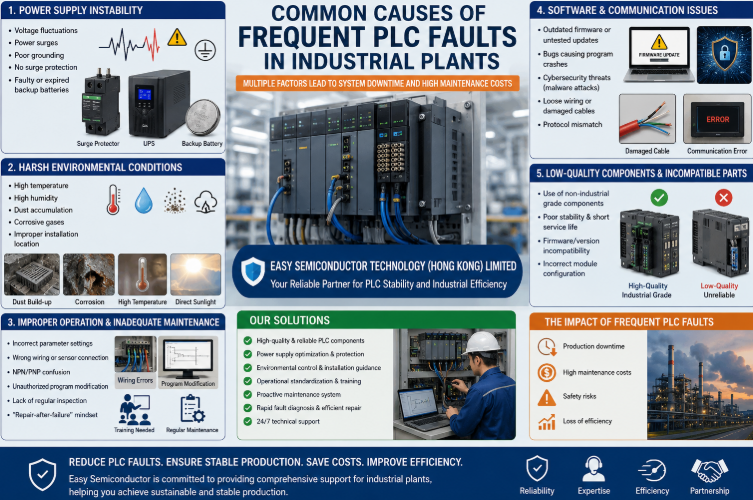
Statistically, power-related issues remain the leading cause of controller failure. Industrial environments are notoriously "noisy" due to the constant cycling of large motors, Welders, and variable frequency drives (VFDs).
Voltage Sags and Swells: Inconsistent power entry can stress the internal capacitors of a controller. Over time, these electrolytic components dry out or leak, leading to a "dead" unit.
Transient Spikes: Sudden surges—often from lightning or inductive switching—can punch through semiconductor insulation, causing immediate catastrophic failure of the CPU or I/O modules.
Heat is the silent killer of semiconductors. While industrial controllers are rated for high temperatures, the micro-climates inside unventilated control panels often exceed these limits.
The "Rule of Ten": A common principle in electronics reliability states that for every 10°C increase in operating temperature, the life expectancy of the semiconductor is halved.
Ventilation Failure: Clogged filters or failed cabinet fans lead to heat stagnation. This causes thermal runaway in high-speed processors, resulting in intermittent resets or permanent logic corruption.
The factory floor is rarely a cleanroom. Despite IP-rated enclosures, microscopic contaminants eventually find their way into the circuitry.
Conductive Dust: Metallic fines or carbon dust can create "parasitic" conductive paths across PCB traces, leading to short circuits.
Chemical Corrosion: In industries involving food processing or chemical manufacturing, airborne corrosive agents (like chlorine or sulfur) attack the copper traces and solder joints, a process known as "creeping corrosion."
Controllers mounted directly on or near heavy machinery are subject to constant harmonic vibration.
Terminal Creep: Over time, vibrations loosen screw terminals. A loose connection increases resistance, which generates localized heat, eventually melting the plastic housing or causing intermittent I/O signals.
Solder Joint Cracking: High-frequency vibration can lead to "cold" or cracked solder joints on the surface-mount components (SMT) inside the controller, which are notoriously difficult to diagnose.
As factories become more connected, the "electromagnetic smog" increases.
Cross-talk: Running low-voltage signal cables parallel to high-voltage motor leads without proper shielding induces noise. This doesn't usually "break" the hardware physically, but it causes "soft failures"—logic errors, communication timeouts, and "ghost" inputs that trigger emergency stops.
Improper Grounding: A "noisy" ground or a ground loop can elevate the reference voltage of the controller, confusing the internal logic gates and leading to erratic behavior.
Every component has a Mean Time Between Failures (MTBF). In 2026, many legacy systems are reaching their end-of-life.
Relay Fatigue: Integrated mechanical relays have a finite number of cycles (often 100,000 to 1,000,000). Once the contacts pit or weld together, the controller can no longer switch loads.
Flash Memory Wear: Repeated logging of data to internal flash memory can lead to "cell exhaustion," where the controller can no longer save its state or boot up after a power cycle.
To mitigate these risks, Easy Semiconductor Technology (Hong Kong) Limited recommends a proactive maintenance framework:
Thermal Audits: Use infrared thermography to identify "hot spots" in control panels before they lead to failure.
Power Conditioning: Install dedicated industrial UPS systems and high-capacity surge suppressors at the panel entry point.
Strict Enclosure Integrity: Ensure all cable glands are sealed and that enclosures remain closed during operation to prevent dust ingress.
Proactive Replacement: Monitor the age of your controllers. If a unit has exceeded its 10-year service life, schedule a replacement during planned downtime rather than waiting for a mid-shift disaster.
We are a premier provider of industrial-grade semiconductors and automation components. Our mission is to supply the global market with the "missing links" of the supply chain, ensuring that your industrial infrastructure remains resilient in the face of the harshest environments.