
 home
home
 Published: May 09, 2026 12:25 PM
 Page View: 141
In the age of continuous manufacturing, the ability to maintain systems without halting production is the ultimate competitive advantage. For industries like oil refining, semiconductor fabrication, and pharmaceutical processing, a total system shutdown for a single module replacement can result in catastrophic financial losses.
At Easy Semiconductor Technology (Hong Kong) Limited, we are pioneering "Hot-Swap" technologies and redundant architectures that allow engineers to pull and replace failed control modules while the process remains live. This news report outlines the technical framework and safety protocols required for zero-downtime maintenance.
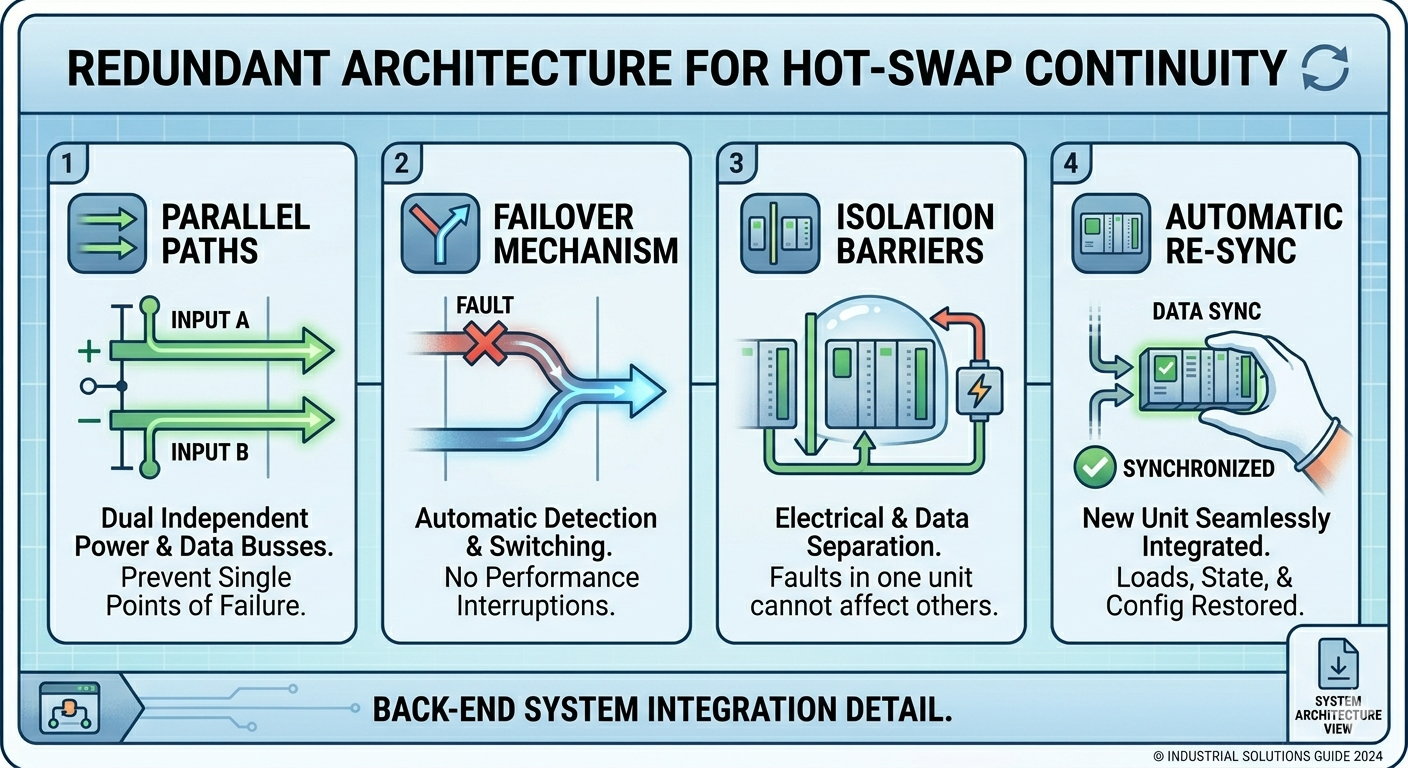
Replacing a module without a shutdown is not as simple as unplugging a peripheral. It requires hardware specifically engineered for live insertion.
Pre-Charge Resistors: High-quality industrial modules from Easy Semiconductor utilize staggered pins. The ground and power pins make contact first, followed by a pre-charge circuit that prevents a massive inrush of current (arc) which could damage the backplane or adjacent modules.
Logic Isolation: The controller’s backplane must be capable of electrically isolating the slot of the failed module so that a short circuit in the damaged hardware doesn't "pull down" the entire communication bus (such as EtherNet/IP or PROFINET).
You cannot safely replace a module in a non-redundant system if that module is actively controlling a critical loop.
1-out-of-2 (1oo2) Architecture: In this setup, two modules run the same logic. If Module A fails, Module B seamlessly takes over the full load. The technician can then replace Module A without the system ever losing control of the field devices.
Active-Standby Sync: Our 2026 controller line features high-speed fiber-optic synchronization between modules, ensuring that the "Memory Image" of the backup is always identical to the primary, down to the millisecond.
Even with hot-swap hardware, technicians must follow a strict procedural sequence to ensure safety.
Status Verification: Check the HMI (Human Machine Interface) to confirm the system has successfully failed over to the redundant partner.
Environmental Shielding: Ensure the technician is properly grounded using an ESD (Electrostatic Discharge) wrist strap. Static electricity is the leading cause of "secondary failure" during live replacements.
Physical Extraction: Unlock the module retainers. Pull the failed unit straight out to avoid bending pins.
Auto-Configuration: Insert the new module. Modern systems from Easy Semiconductor will automatically detect the new hardware, verify the firmware version, and download the current logic and parameters without manual intervention.
A physical swap is only half the battle. The software must be robust enough to handle the sudden disappearance and reappearance of hardware.
I/O Forcing: In some cases, maintenance requires "forcing" certain I/O points to a specific state to prevent the system from triggering an Emergency Stop (ESTOP) when a module is removed.
Firmware Mismatch Prevention: Our systems automatically check if the replacement module has an older or newer firmware than the system standard. If a mismatch is detected, the system performs an "Auto-Flash" to ensure compatibility before bringing the module online.
Despite the technology, human error remains a risk. Easy Semiconductor recommends:
Mechanical Interlocks: Using cabinets that only allow access to specific slots when the system is in "Maintenance Mode."
Visual Indicators: LED diagnostic codes on the module faceplate that clearly show a "Safe to Remove" status (often a solid blue or green light).
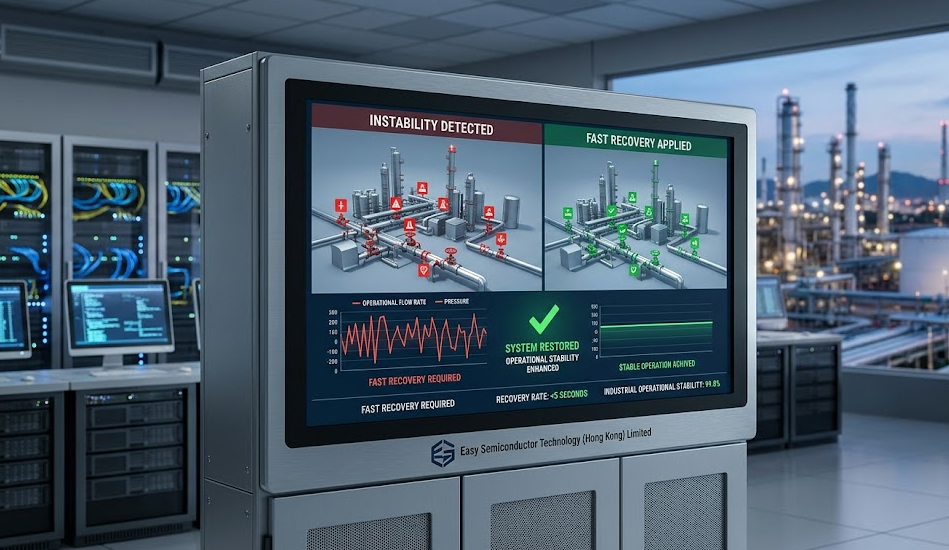
Easy Semiconductor is a leader in high-reliability industrial components. We provide the "Active Backplane" technology and "Fault-Tolerant" processors that power the world’s most critical infrastructure. Based in Hong Kong, we serve the global automation market with a focus on resilience, speed, and zero-downtime engineering.