
 home
home
 Published: Apr 02, 2026 03:19 PM
 Page View: 206
Released by: Easy Semiconductor Technology (Hong Kong) Limited | Release Date: April 2, 2026
In the era of rapid development of industrial automation, the PLC (Programmable Logic Controller) panel, as the "control center" of the entire automation system, undertakes the core mission of signal collection, logical operation and command execution. It is a key bridge connecting industrial equipment and control systems. Easy Semiconductor Technology (Hong Kong) Limited (hereinafter referred to as "Easy Semiconductor"), with years of experience in the industrial automation field, comprehensively analyzes the core components, working principle, mainstream types, wide-ranging applications and core advantages of PLC panels, helping enterprises in various industries deeply understand PLC panels, optimize automatic production efficiency, and empower industrial digital transformation.
As a core control equipment in the field of industrial automation, the stable operation of the PLC panel directly determines the smoothness and reliability of the production process. Easy Semiconductor has always focused on the R&D and supply of industrial automation components, providing a full range of products including PLC panels, PLC modules and industrial sensors. With high-quality and high-compatibility solutions, it meets the automation control needs of various industries such as petrochemical, semiconductor manufacturing and power energy, and promotes the implementation of Industry 4.0.
I. Core Components of PLC Panel: The "Cornerstone" of Automatic Control
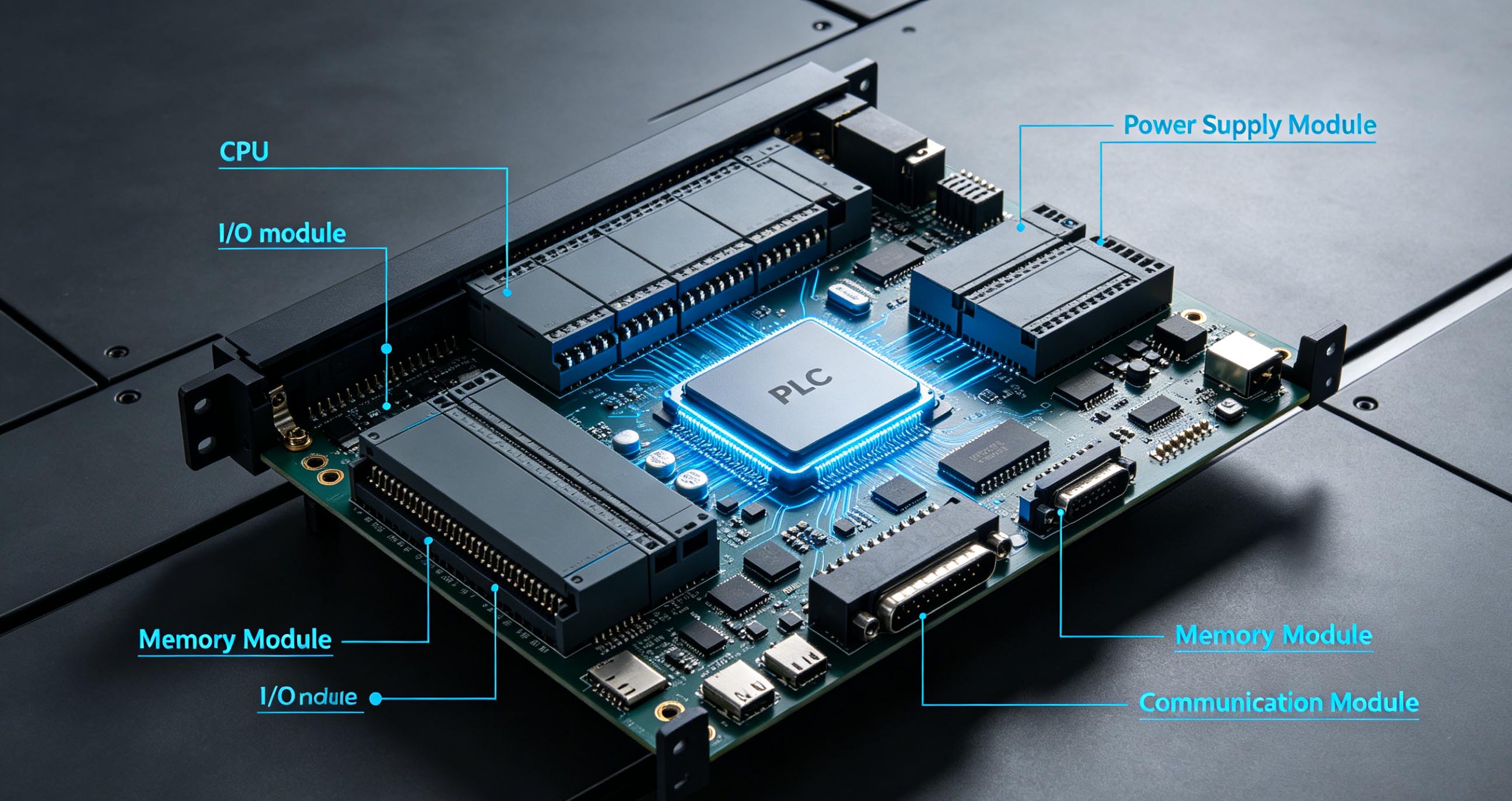
A PLC panel is not a single component, but an integrated system that works collaboratively with multiple functional modules. Each component plays an indispensable role in ensuring the efficient operation of the PLC panel. Combining industry practices, Easy Semiconductor sorts out the five core components of the PLC panel to help enterprises accurately understand its structure and functions:
• Central Processing Unit (CPU): As the "brain" of the PLC panel and the core of the entire system, it is responsible for reading the control program written by the user, processing signals from the input module, executing logical operations and data processing, and sending control instructions to the output module to ensure that all equipment operates collaboratively in accordance with the preset process. The industrial-grade CPU has strong anti-electromagnetic interference capability, which can adapt to harsh industrial environments and ensure the real-time response of control logic.
• Input/Output (I/O) Module: The "interface" connecting the PLC panel with external equipment (sensors, buttons, motors, valves, etc.), divided into input modules and output modules. The input module is responsible for collecting signals from external equipment (such as detection signals from sensors and switch signals from buttons) and converting them into electrical signals recognizable by the PLC. The output module converts the weak electrical signals sent by the central processing unit into level signals to drive the executive components of the controlled equipment (such as contactors, solenoid valves, indicator lights, etc.). Most I/O modules adopt photoelectric coupling circuits to reduce electromagnetic interference and improve reliability.
• Power Supply Module: The "power source" of the PLC panel, which is used to convert AC power into DC power required inside the PLC, supplying power for the operation of internal electronic circuits such as CPU, memory and I/O interface. Most PLCs adopt switching power supplies, which can also provide DC power for input equipment in some cases, ensuring stable power supply and strong anti-interference performance.
• Memory Module: It is divided into system program memory and user program & data memory. The system program memory mainly stores system management, monitoring programs and programs for compiling user programs, which are fixed by the manufacturer and cannot be modified by the user. The user program & data memory is used to store the application programs compiled by the user, logical variables, various temporary data and intermediate results.
• Communication Module: An important component to realize the networking and data interaction of PLC panels. It supports multiple communication protocols (such as Modbus, Profibus, Ethernet/IP), enabling the PLC panel to connect with upper computers, touch screens, other PLCs and industrial control networks, realizing remote monitoring, data transmission and centralized control, which is an important guarantee for the intelligent development of industrial automation systems.
The picture below shows the overall structure of the PLC panel and the distribution of core components, which intuitively reflects the collaborative relationship between each module: