

 home
home
 Published: Jun 02, 2026 12:29 PM
 Page View: 120
As industrial automation systems become increasingly sophisticated, Programmable Logic Controllers (PLCs) remain at the core of modern manufacturing operations. Among the most widely adopted PLC platforms worldwide, Siemens S7 series controllers are recognized for their reliability, scalability, and integration capabilities. From automotive assembly lines and food processing plants to energy facilities and logistics centers, Siemens S7 PLCs play a critical role in ensuring operational efficiency and production continuity.
However, even the most advanced PLC systems can experience performance limitations if they are not properly configured and maintained. Optimizing Siemens S7 PLCs can significantly improve system responsiveness, reduce downtime, and enhance overall production efficiency. This article explores practical optimization strategies for industrial applications using Siemens S7 PLC systems.
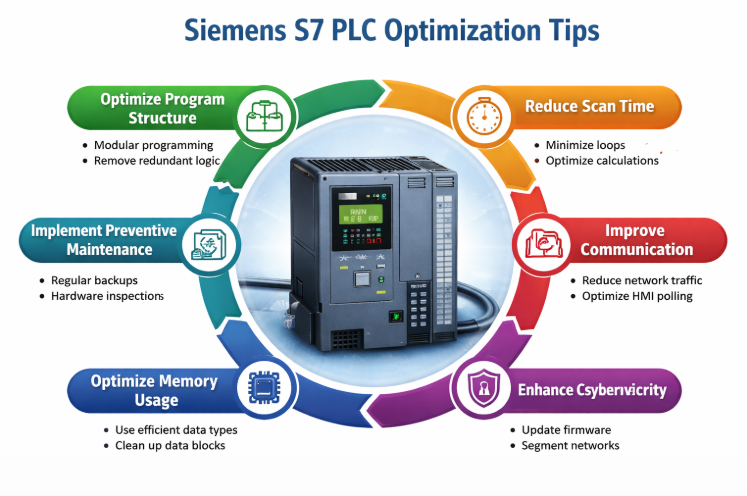
The Siemens S7 family includes popular models such as S7-1200, S7-1500, and legacy S7-300/S7-400 systems. These controllers are designed to execute control logic, process field data, communicate with industrial networks, and interact with Human Machine Interfaces (HMIs) and Supervisory Control and Data Acquisition (SCADA) systems.
PLC performance depends on several factors, including:
CPU processing capability
Program structure
Communication efficiency
Memory utilization
Network configuration
Input/output response time
Proper optimization addresses each of these areas to maximize system performance.
One of the most effective ways to improve PLC performance is through efficient program design.
Large monolithic programs are difficult to maintain and can increase scan times. Siemens recommends organizing applications into:
Function Blocks (FB)
Functions (FC)
Data Blocks (DB)
Organization Blocks (OB)
Modular programming improves readability, troubleshooting efficiency, and execution performance.
Repeated calculations and duplicate instructions consume unnecessary CPU resources.
Optimization techniques include:
Calculating values once and storing them in variables
Reusing existing functions
Removing obsolete code sections
Simplifying nested conditions
Reducing program complexity directly contributes to faster scan cycles.
Not all control operations require the same execution frequency.
For example:
Safety functions require immediate processing
Temperature monitoring may tolerate slower update rates
Reporting tasks can run in lower-priority cycles
Using appropriate OB priorities ensures critical processes receive sufficient CPU resources.
Scan time refers to the duration required for the PLC to complete one full execution cycle.
Long scan times can lead to:
Delayed responses
Inaccurate process control
Communication bottlenecks
To reduce scan time:
Large FOR and WHILE loops can significantly increase execution time.
Instead:
Process data incrementally
Limit loop iterations
Use efficient data structures
Complex calculations should be optimized whenever possible.
Examples include:
Pre-calculating constants
Using lookup tables
Performing advanced calculations in external systems
This reduces CPU load while maintaining accuracy.
TIA Portal provides diagnostic tools that allow engineers to monitor:
CPU utilization
Scan cycle duration
Memory usage
Regular monitoring helps identify performance issues before they affect production.
Industrial facilities increasingly rely on networked automation systems.
Siemens PLCs commonly communicate through:
PROFINET
PROFIBUS
Industrial Ethernet
Modbus TCP
OPC UA
Poor communication design can negatively affect PLC performance.
Avoid transmitting unnecessary data.
Recommended practices include:
Sending only required variables
Using efficient data structures
Reducing polling frequency
Implementing event-driven communication
This minimizes network congestion and improves response times.
HMIs frequently request data from PLCs.
To improve efficiency:
Group variables into optimized data blocks
Limit screen refresh rates
Avoid excessive tag polling
These measures reduce communication overhead.
Separating automation traffic from enterprise traffic improves reliability and security.
Dedicated industrial networks help:
Reduce latency
Improve determinism
Prevent bandwidth conflicts
This is particularly important in large manufacturing environments.
Memory resources directly influence PLC performance.
Selecting appropriate data types can reduce memory consumption.
Examples:
BOOL for binary states
INT for standard integers
REAL only when floating-point precision is required
Avoid allocating larger data types than necessary.
Well-structured data blocks improve both performance and maintenance.
Recommendations include:
Group related variables together
Remove unused tags
Use symbolic addressing consistently
Optimized data structures can enhance execution efficiency.
PLC memory should not be used for long-term data storage.
Instead, transfer historical information to:
SCADA systems
Industrial databases
Cloud platforms
This preserves controller resources for real-time operations.
Modern Siemens PLCs include extensive diagnostic capabilities.
Key tools available in TIA Portal include:
Online diagnostics
Trace functions
Performance monitoring
Communication analysis
Error logging
Regular diagnostics provide valuable insights into:
CPU overload conditions
Network issues
Hardware failures
Programming inefficiencies
Proactive monitoring enables predictive maintenance and reduces unexpected downtime.
Cybersecurity has become a critical aspect of industrial automation optimization.
A compromised PLC can lead to:
Production interruptions
Data loss
Equipment damage
Safety hazards
Recommended security measures include:
Regular firmware updates
Strong password policies
Network segmentation
Firewall deployment
User access control
Secure remote access solutions
Protecting PLC infrastructure ensures stable and reliable operations.
Optimization is not a one-time activity. Continuous maintenance is essential for sustaining performance.
Preventive maintenance tasks should include:
Firmware verification
Backup validation
Communication testing
Hardware inspections
Power supply checks
Environmental monitoring
Scheduled maintenance minimizes unexpected failures and extends equipment lifespan.
The evolution of Industry 4.0 is transforming PLC deployment strategies.
Emerging technologies include:
AI-assisted diagnostics
Edge computing integration
Digital twins
Predictive maintenance analytics
Cloud-connected automation systems
Siemens continues to enhance the S7 platform with advanced processing capabilities and improved connectivity, enabling manufacturers to achieve greater operational efficiency.
Siemens S7 PLCs remain a cornerstone of industrial automation worldwide. Through effective program design, reduced scan times, optimized communications, efficient memory management, robust cybersecurity practices, and proactive maintenance, manufacturers can significantly improve system performance and reliability.
As production environments become increasingly connected and data-driven, optimizing Siemens S7 PLC systems is no longer optional—it is essential for maintaining competitiveness, maximizing uptime, and supporting sustainable industrial growth.
By adopting these optimization strategies, industrial organizations can fully leverage the capabilities of Siemens S7 PLC technology and build a strong foundation for future smart manufacturing initiatives.
About Easy Semiconductor Technology (Hong Kong) Limited
Easy Semiconductor Technology (Hong Kong) Limited specializes in industrial automation components, PLC systems, control solutions, electronic components, and technical support services for global manufacturing and industrial customers. The company is committed to helping businesses improve operational efficiency, system reliability, and automation performance through high-quality industrial technology solutions.